Vibrating Void, the Tempi Memorial


Project idea
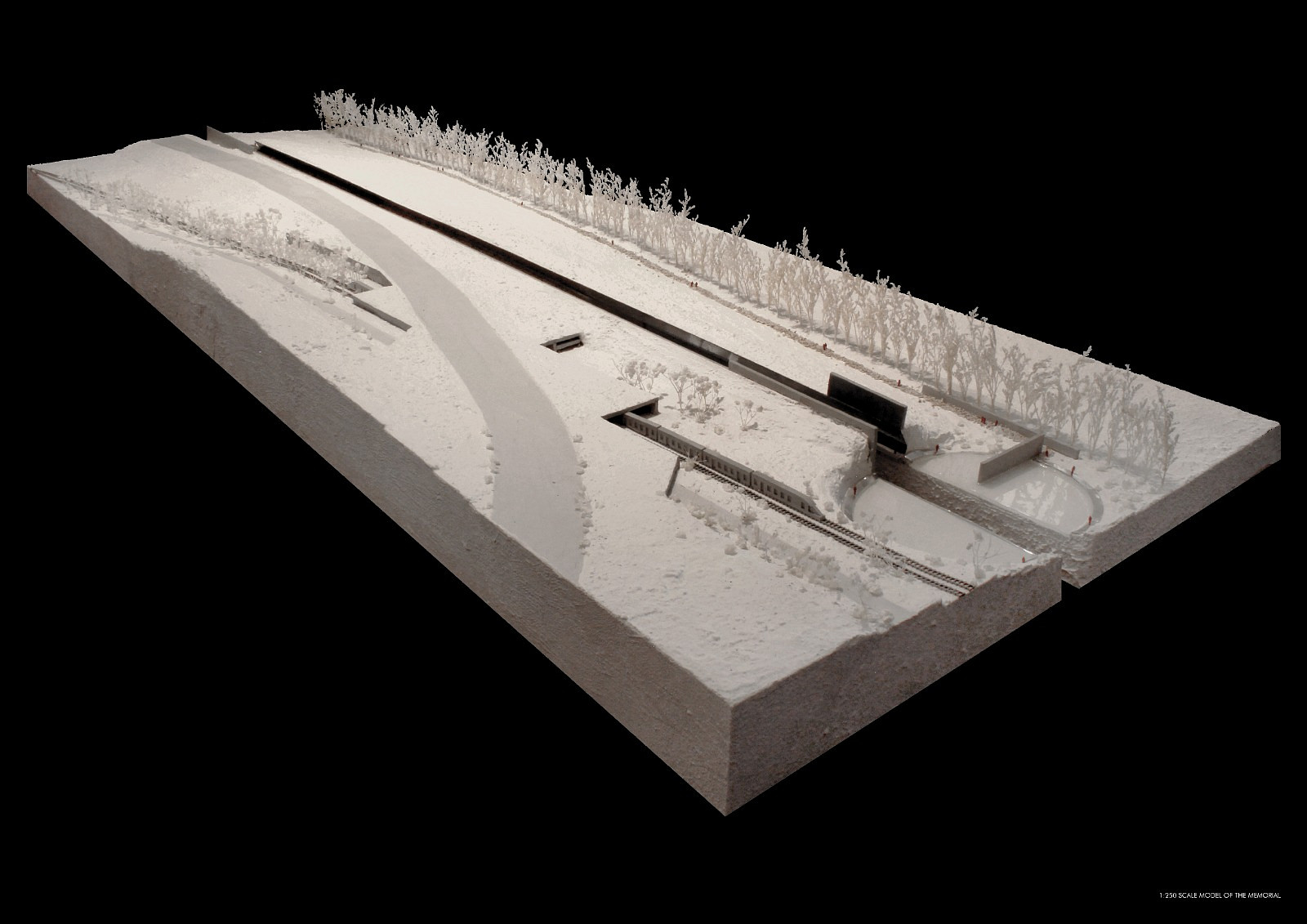
This project proposes a memorial architecture at the site of the Tempi train collision of February 28, 2023, at the location of the incident, in Tempi, Greece, where collective loss is not represented but spatially enacted. The memorial is conceived as an experiential apparatus that transforms grief from an abstract condition into a bodily and temporal encounter. Its central premise is that memory does not reside in images or symbols, but in the way space is entered, traversed and inhabited.
Rather than producing an object of commemoration, the project constructs a sequence of spatial states that gradually withdraw the visitor from everyday rhythms and reorient perception toward slowness, attention and vulnerability. Architecture operates here as a medium of transition: from landscape to interior, from light to darkness, from stability to disturbance. The memorial begins before it is formally encountered, unfolding through thresholds that recalibrate movement, sound and orientation, preparing the body for a condition of heightened awareness.
The project positions memory as a dynamic and relational phenomenon. Individual loss and collective trauma are not merged into a single narrative but held in tension through spatial organization, material differentiation and sensory modulation. The architecture resists spectacle and monumentality, favoring precision, restraint, and duration. It does not seek to console or resolve, but to sustain a space in which absence can be perceived as presence.
At its core, the memorial articulates an understanding of remembrance as an active process, one that unfolds in time and is continually reactivated by the living landscape. The passage of the train, the vibration of water, the shifting intensity of sound and light transform the site into a responsive field where memory is never fixed, but repeatedly unsettled. Architecture thus becomes a framework for encounter rather than representation: a space where loss is neither narrated nor illustrated, but physically and sensorially registered.
Project description
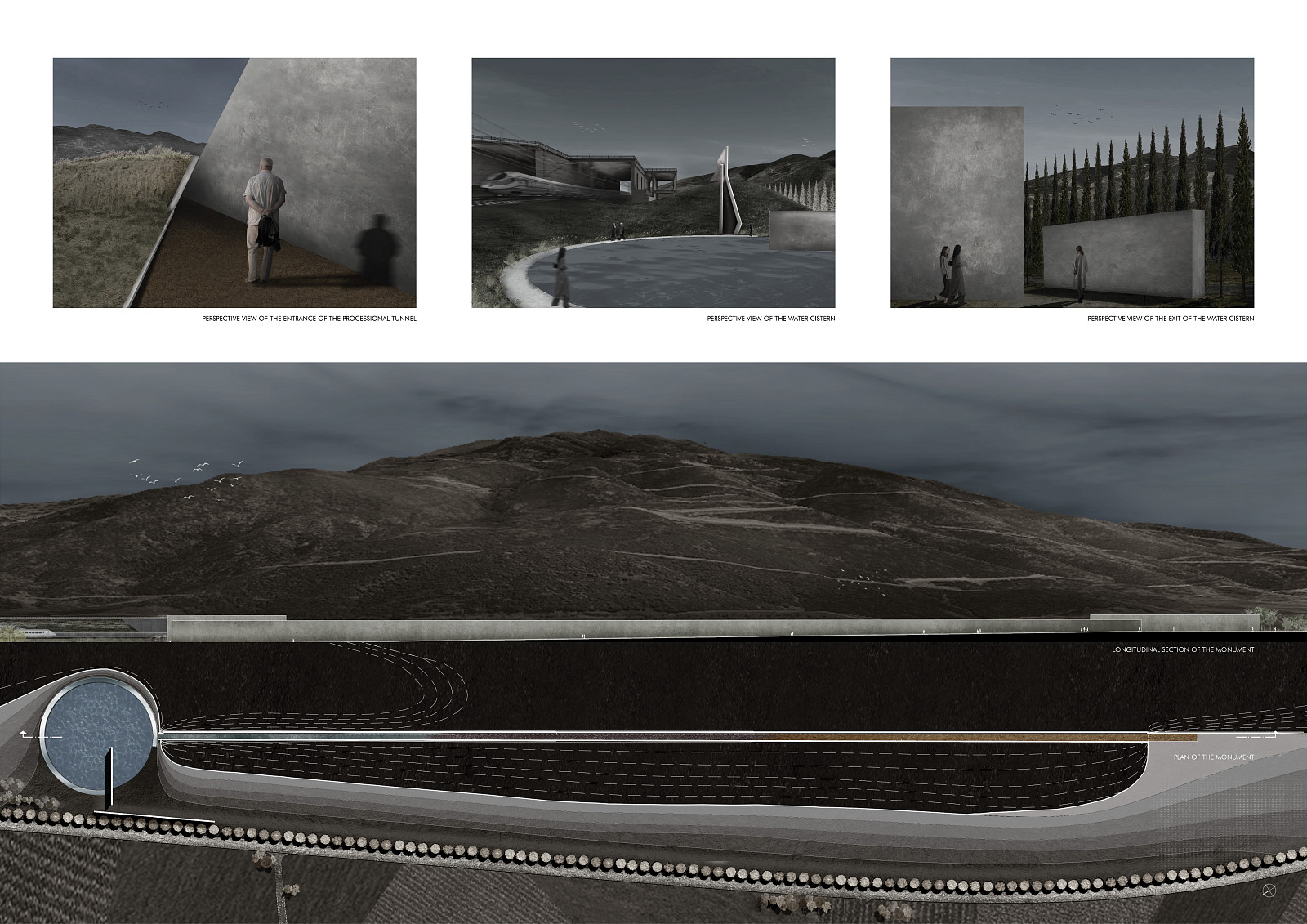
The memorial unfolds as a carefully choreographed spatial sequence in which geometry, materiality, sound and light are progressively transformed in order to regulate bodily perception and temporal awareness. Its core architectural gesture is a descending 400 meters underground tunnel, conceived not as a passage but as an instrument that gradually reconfigures the visitor’s relationship to space, movement and memory.
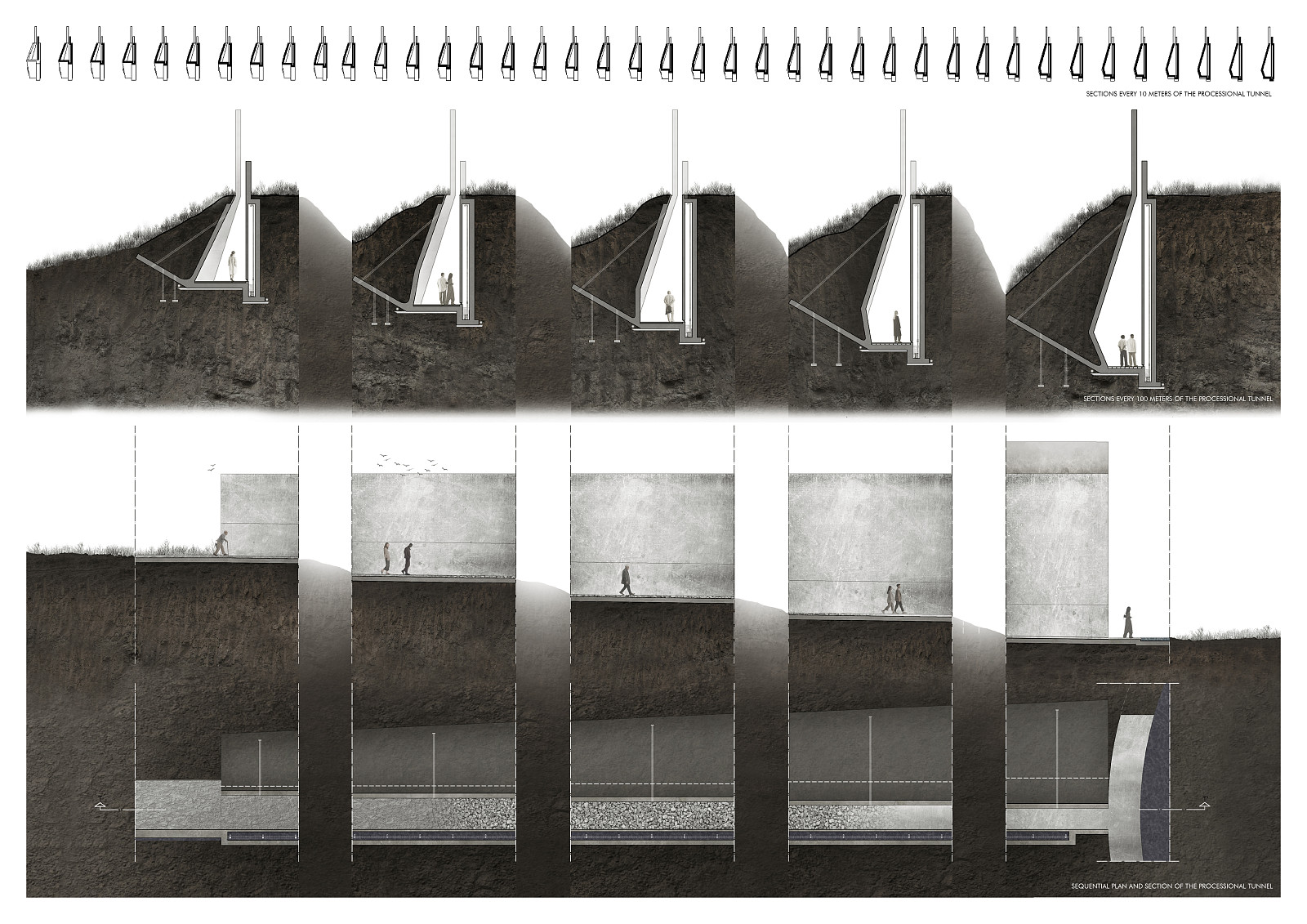
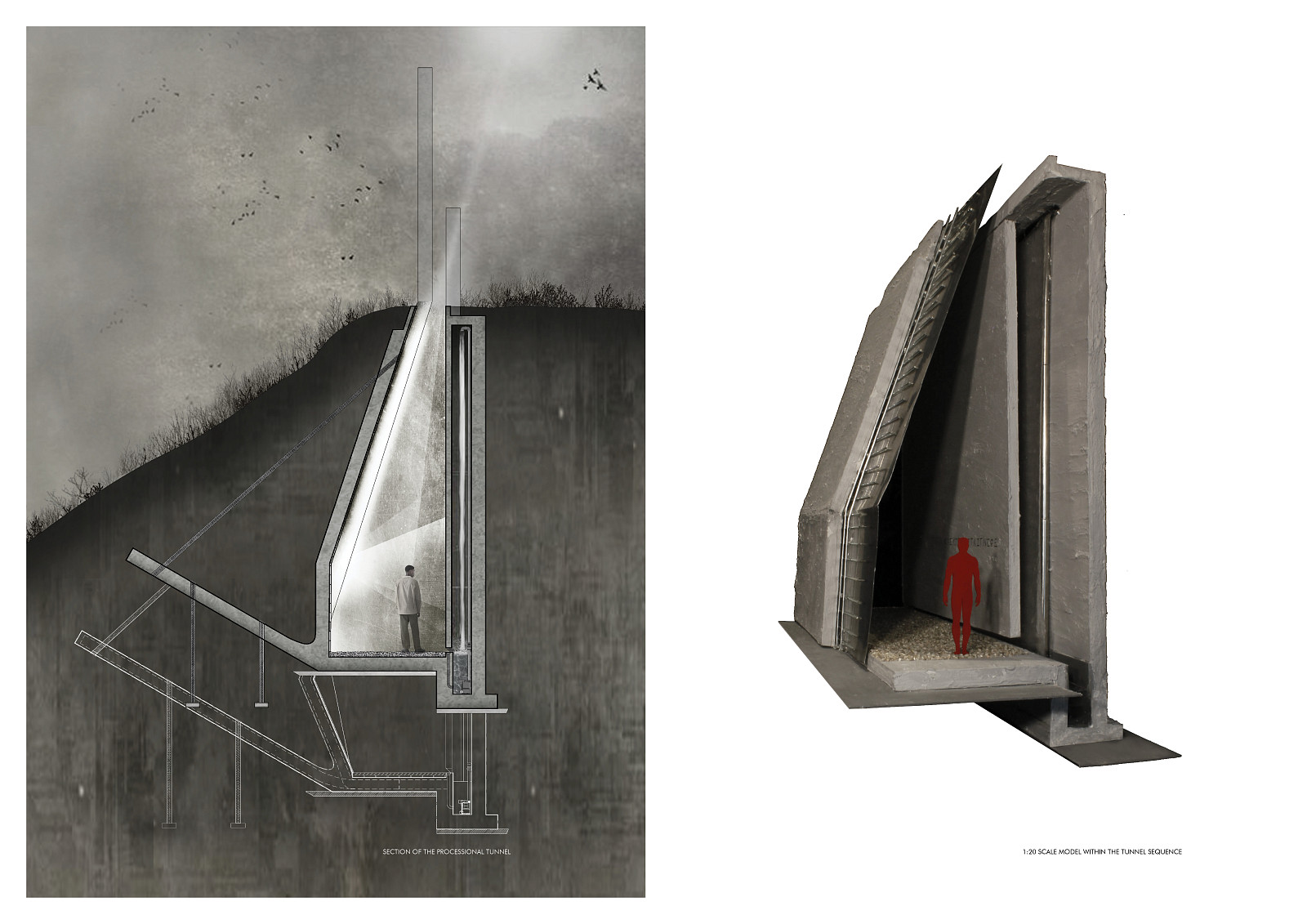
The tunnel’s geometry is defined by a continuous sectional transformation. It begins with a triangular cross-section, establishing an initial sense of orientation and stability and as the visitor descends, the section gradually mutates into an inverted trapezoidal form. This transformation produces a dual spatial condition, lateral compression combined with vertical expansion, where the body experiences confinement at shoulder level while simultaneously confronting an increasing vertical void, intensifying spatial awareness and psychological tension. Geometry thus becomes an active medium, shaping perception rather than merely enclosing movement.
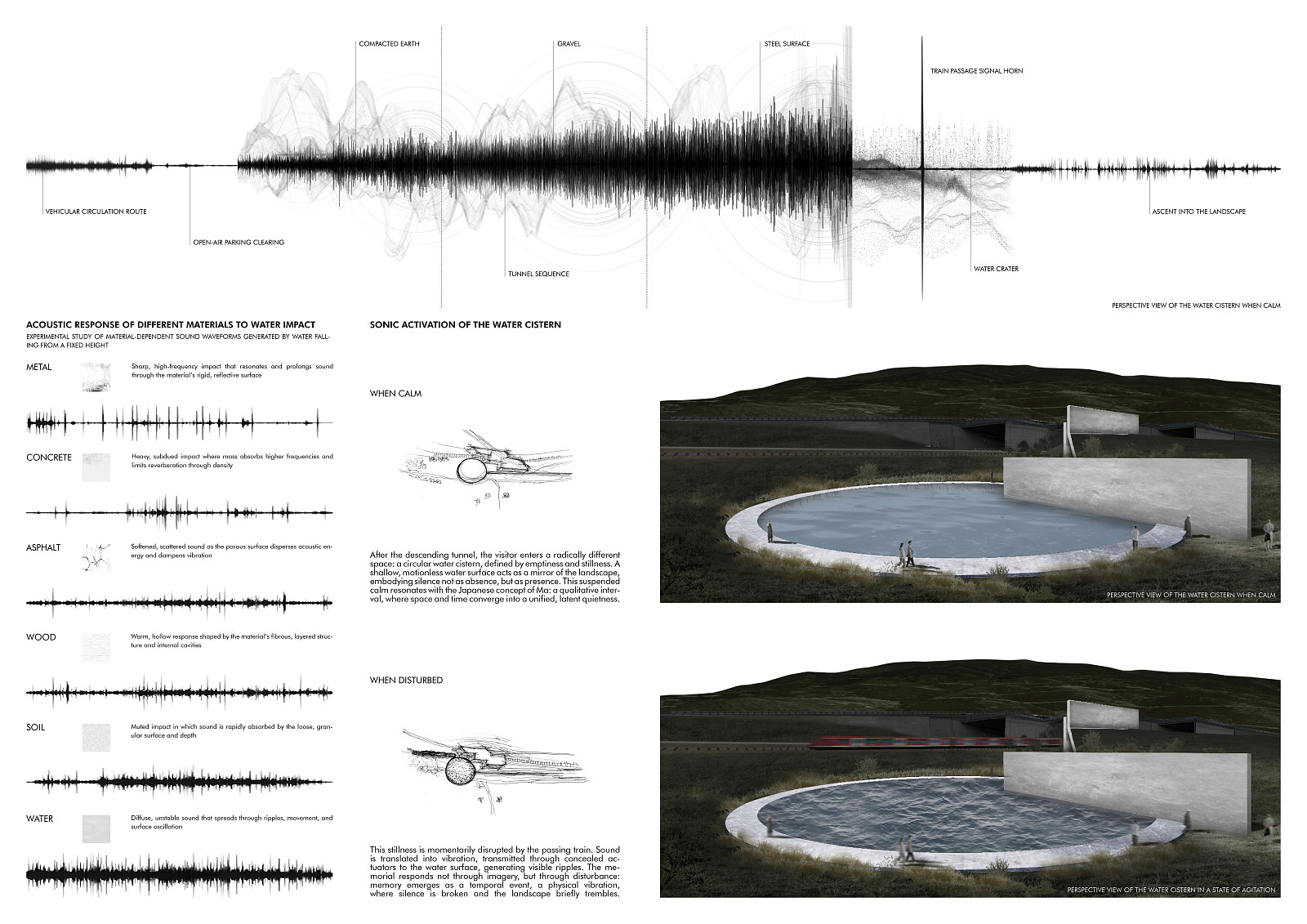
Material transitions reinforce this transformation through the body. The floor is composed as a continuous yet perceptible sequence, with compacted earth at the entrance, gravel at the mid-point and steel at the final stretch, where the transition is not visually emphasized but tactically registered through the footstep. The compacted earth absorbs sound and stabilizes pace, gravel introduces instability and acoustic feedback, prompting unconscious deceleration and steel produces a sharper, colder resonance, amplifying each movement. Walking becomes measured and deliberate, as the ground itself regulates rhythm. The visitor does not choose to slow down, but the space imposes its own temporal logic.
Light is treated not as illumination but as a diminishing atmospheric substance, where a continuous linear skylight runs along the apex of the tunnel. As the geometry expands vertically and compresses laterally, the reduction of light intensifies the sense of depth and withdrawal. Light does not reveal form; it recedes, darkens and withdraws, guiding perception inward. An inclined metal surface along one wall softly reflects this diminishing light onto the engraved names, ensuring legibility without glare, shadow or spectacle.
The engraved names of the victims are not arranged alphabetically but according to relational proximity, family ties, friendships, shared journeys. This non-hierarchical, non-systematic ordering preserves the individuality of each life while acknowledging the human networks abruptly severed by the event. The inscriptions are not decorative elements, but narrative anchors embedded within the architectural surface. Each name occupies a position of relational meaning, allowing personal memory to coexist with collective remembrance without subsumption.
Sound further intensifies the spatial experience through an unseen vertical water cascade concealed behind the concrete wall. The falling water produces a continuous, natural acoustic presence that grows louder as the visitor descends, while its source remains invisible. This acousmatic condition, sound without visual confirmation, heightens sensory alertness and destabilizes spatial certainty. Sound does not accompany space; it constructs it.
The tunnel terminates in a circular, open void: a shallow water basin that functions as the memorial’s silent core. Here, the project draws conceptually from the Japanese notion of Ma, not as emptiness, but as a charged interval where time, silence and presence converge. The circular space is defined by stillness and reflection, a suspended moment where the architectural sequence momentarily halts. This condition, however, is not static. When a train passes on the adjacent railway line, its horn activates a concealed system that translates sound into vibration, transmitting a subtle oscillation to the water surface. The landscape trembles. Silence is disturbed, made momentarily visible.
This disturbance is not representational but phenomenological. Memory is not recalled through image or symbol, but through the sudden activation of an apparently inert environment. The memorial responds to the ongoing reality of the site, allowing the external world to interrupt stillness, transforming absence into a temporal event. In this moment, architecture does not depict loss, it allows it to be felt.
Technical information
The memorial is constructed as a predominantly underground reinforced concrete structure, embedded within the existing terrain to minimize visual impact and preserve the continuity of the landscape. The primary architectural element is a descending tunnel with a variable cross-section, designed to operate simultaneously as spatial sequence and load-bearing structure.
The tunnel is formed in cast-in-place reinforced concrete with a constant wall thickness of 0.30 m. Its cross-section transitions gradually from a triangular profile (5.0 m height × 3.0 m width) to an inverted trapezoidal section (10.0 m height × 2.0 m width). This geometric transformation generates significant asymmetrical loads and increased overturning moments, particularly along the inclined wall. Initial structural analysis indicated that conventional reinforcement alone would lead to excessive steel requirements and reduced constructability.
To address this, a combined stabilization strategy is implemented. A passive system is introduced through a reinforced concrete inclined slab set at 30°, designed to mobilize the self-weight of the surrounding soil as counterbalance. This is complemented by an active system of prestressed ground anchors positioned at the upper portion of the inclined wall, significantly reducing bending moments and tensile stresses. The hybrid system ensures structural stability, material efficiency, and long-term durability while maintaining the intended spatial geometry.
Material selection throughout the tunnel is driven by tactile, acoustic and atmospheric performance rather than visual expression. Exposed concrete is used as the primary surface for its mass, durability, and acoustic absorption. A secondary inclined metal surface, constructed in brushed stainless steel, is introduced to reflect diminishing natural light indirectly onto the engraved names, preventing glare and maintaining legibility under low-light conditions.
The floor system is composed of three sequential materials laid continuously without visible joints: compacted stabilized earth, loose gravel and steel plates. Each material is selected for its distinct acoustic response and friction coefficient, allowing the floor to regulate walking speed through bodily feedback. The transition between materials is gradual, ensuring perceptual continuity rather than abrupt change.
Natural lighting is provided exclusively through a linear skylight running along the tunnel’s apex, narrowing from 0.60 m to 0.20 m. This reduction corresponds directly to the sectional transformation, reinforcing the spatial compression and withdrawal from daylight without artificial illumination.
The acoustic system integrates a concealed vertical water cascade located behind the concrete wall. Water falls freely from varying heights (5.0 m – 10.0 m) into a linear channel, generating continuous natural sound without mechanical amplification. The source remains invisible, producing an acousmatic condition that heightens spatial perception.
The terminal circular basin (12.0 m diameter, 0.20 m depth) incorporates a vibration activation system. External acoustic input from passing trains is captured and translated into low-frequency signals that activate submerged electromechanical vibrators fixed beneath the basin slab. These induce controlled surface oscillations on the water, making sound perceptible as movement. The system operates intermittently, ensuring minimal energy consumption and preserving the basin’s default state of stillness.
All mechanical, acoustic and structural systems are fully concealed, prioritizing perceptual clarity, robustness, and minimal maintenance, while ensuring that construction logic remains inseparable from the architectural concept.

Copyright © 2026 INSPIRELI | All rights reserved. Use of this website signifies your agreement to the Terms of Use, Privacy Policy, and use of cookies.